The xPhysician: Reimagining Medical Practice in the AI Era
AI won’t replace physicians, but it will redefine them. As knowledge shifts from memory to machine, the xPhysician emerges: an AI-augmented generalist who combines deep expertise with end-to-end ownership, reshaping how medicine is practiced and learned.

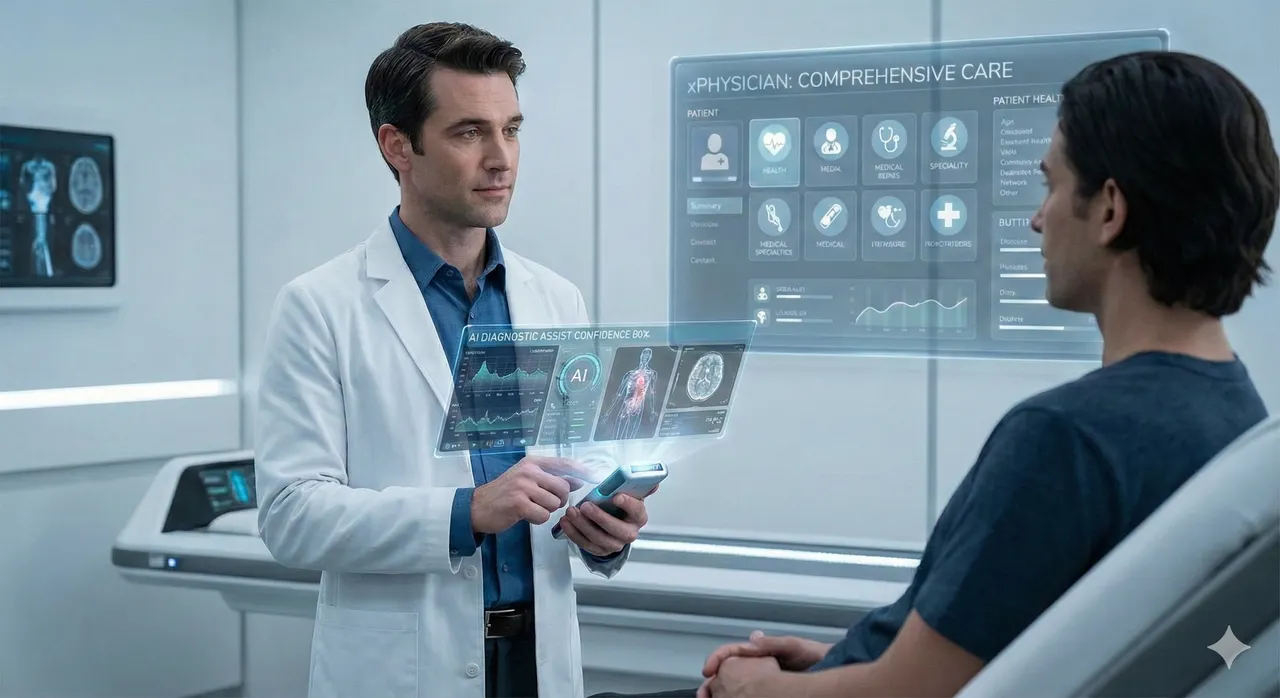
Why Elon Musk Is Wrong About Medical Schools (But Right About Change)
Elon Musk recently suggested that medical schools may no longer be necessary in the age of AI. He's wrong about the conclusion, but right that something fundamental is shifting. AI won't replace physicians. But it will fundamentally reshape what it means to be a physician, and which specializations remain relevant.
The tech industry is already ahead of us on this transformation. Aviran Mordo, VP of Engineering at Wix, recently announced they're unifying their Frontend, Backend, and Mobile engineering guilds into a single Engineering Guild, creating what they call the "xEngineer": an AI-augmented engineer who leverages AI as an integral part of every workflow while maintaining deep expertise in a core domain. This isn't about making engineers obsolete; it's about reimagining the engineering role for an AI-native world.
Tech companies are embracing AI faster than any other sector, and their organizational changes serve as early indicators of where other knowledge-intensive industries are heading. The parallels to medicine are striking. Just as tech fragmented into specialized roles because no single engineer could master every stack, medicine fragmented into subspecialties because no physician could hold all medical knowledge. And just as AI is now enabling tech's return to end-to-end ownership through AI-augmented generalists, the same transformation is coming to healthcare.
What I'm seeing isn't the end of medical training. It's the emergence of a new archetype: the xPhysician, an AI-augmented generalist who leverages artificial intelligence as an integral copilot while maintaining deep diagnostic proficiency and patient interaction skills.
This isn't about making physicians obsolete. It's about liberating them from the impossible burden of memorizing and synthesizing vast amounts of medical knowledge, allowing them to focus on what humans do best: diagnostic reasoning, patient connection, asking the right questions, and validating AI recommendations in context.
The Knowledge vs. Technical Skills Divide
To understand what's changing, we need to distinguish between two fundamental types of medical expertise:
Knowledge and Experience-Based Practice: Internal medicine, neurology, psychiatry, endocrinology, rheumatology, and most cognitive subspecialties. These fields depend primarily on pattern recognition, differential diagnosis, synthesizing complex information, and applying vast medical knowledge to individual cases.
Technical and Procedural Skills: Surgery, interventional cardiology, interventional radiology, endoscopy, and other procedure-heavy specialties. These depend on manual dexterity, spatial reasoning, real-time decision-making under pressure, and skills that require extensive hands-on training.
AI is about to completely transform the first category while leaving the second largely intact for now. Not because AI can't help with procedures (it can and will), but because the knowledge burden that drove subspecialization in cognitive medicine is exactly what AI excels at handling. Procedural specialties will face their own transformation as robotics in healthcare matures, but that's a different timeline with different challenges. For now, the immediate revolution is in knowledge-based practice.
Why We Created So Many Subspecialties
Medical specialization exploded over the past 50 years for one simple reason: no single human could hold all the necessary medical knowledge in their head.
In 1970, a general internist could reasonably stay current with most of internal medicine. By 2000, that was impossible. The volume of medical literature, drug interactions, rare disease presentations, and treatment guidelines had grown exponentially. We responded by fragmenting medicine into increasingly narrow subspecialties.
Cardiology split into general cardiology, interventional cardiology, electrophysiology, heart failure, and advanced imaging. Gastroenterology divided into hepatology, inflammatory bowel disease, motility, and advanced endoscopy. Pulmonology separated into critical care, interstitial lung disease, and sleep medicine. Each subspecialist maintained deep expertise in a narrow domain because that's all a human brain could manage.
This fragmentation solved the knowledge problem but created new ones: patients bouncing between specialists, no one owning the whole picture, coordination failures, and the "tyranny of the expert" where each specialist optimizes for their narrow view.
What AI Changes Fundamentally
AI doesn't just make physicians faster. It eliminates the primary reason subspecialization existed: the limitation of human memory and information synthesis.
A well-designed AI copilot has instant access to:


