The Two Faces of Digital Twins: Your Body vs. Your Doctor
Digital twins are moving from factories to hospitals. We’re building replicas of patients, modeling disease in real time, and of physicians, capturing decades of expertise. The twin extends capacity while preserving oversight. What will happen when they no longer need us in between?

A few years ago, when IoT was as hot as AI is today, I led a team at SAP working on real-time monitoring solutions for consumer products and pharmaceutical companies. This was part of SAP's broader Industry 4.0 initiative, where Industrial Internet of Things (IIoT), artificial intelligence, cyber-physical systems, big data, and advanced robotics were converging to transform manufacturing.
We handled massive streams of sensor data, ran machine learning models for anomaly detection and predictive analytics, and enabled real-time visibility into production systems that could spot problems before they cascaded into failures.
Digital twins were part of this ecosystem, virtual replicas of production lines that could simulate "what-if" scenarios, predict equipment failures weeks in advance, and test new configurations without interrupting live operations. The value was immediate and tangible. A pharmaceutical manufacturer could optimize batch scheduling, reduce waste, ensure product quality, and prevent costly downtime.
We weren't just monitoring assets. We were creating systems that could see the future, test alternatives, and optimize performance in real time.
Now, that same technology is coming to healthcare. But with a twist that never existed in manufacturing.
In a factory, you build a digital twin of the thing, the production line, the packaging system, the supply chain. The twin optimizes the asset. The human operates it.
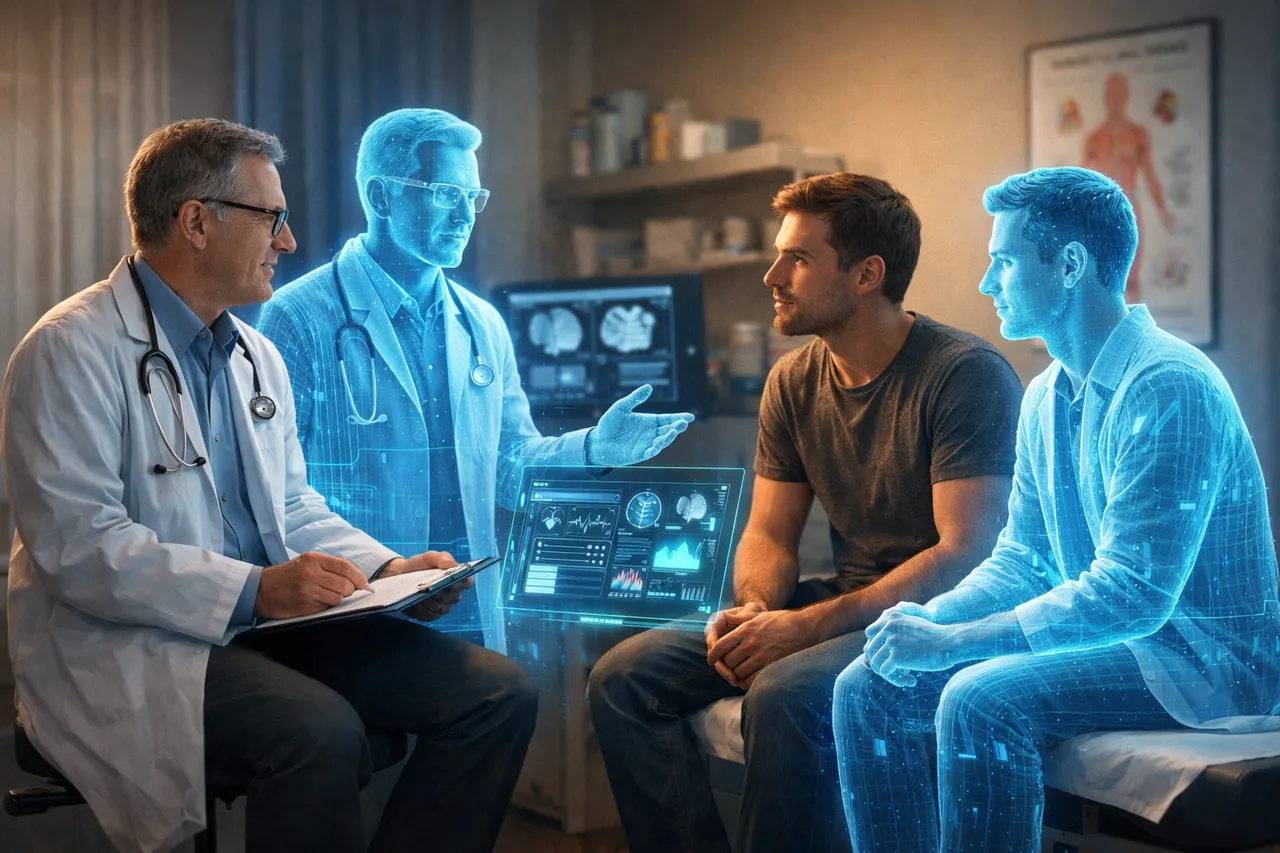
In healthcare, we're building digital twins of both sides of the exam table.
We're creating virtual replicas of patients, modeling tumor growth, predicting glucose levels, simulating how a specific heart will respond to a specific drug. These patient digital twins track disease progression across weeks and months, adapting treatment in real time as the biology changes.
And simultaneously, we're creating virtual replicas of physicians, capturing decades of diagnostic expertise, compressing clinical pattern recognition into conversational interfaces, replicating the judgment calls that come from 10,000 patient encounters.
One twin predicts how your cancer will respond to chemotherapy. The other twin replicates your oncologist's 30 years of experience deciding which chemotherapy to try first.
The question isn't which digital twin we need.
It's which one comes first, and what happens when they start talking to each other.
Digital Twins of Patients: The Body as a Predictive System
When I was working on pharmaceutical logistics monitoring, predictive analytics was the killer application. Monitor performance patterns, track quality metrics over time, analyze degradation before it impacts output, and intervene before failure happens.
The same principle applies to the human body, but with stakes measured in lives instead of downtime.
A patient digital twin is a virtual replica that evolves alongside the real person, integrating genetic sequencing, medical imaging, lab results, wearable device readings, and electronic health records. The Lancet Digital Health defines five essential components: the patient, data connection, patient-in-silico (the virtual model), interface, and twin synchronization (continuous updating as new data arrives).
That last component, twin synchronization, separates a digital twin from a static predictive model. Just as a factory digital twin updates in real time, a patient digital twin evolves as the patient's condition changes. It's not a snapshot. It's a living system.
Adaptive Cancer Therapy: Learning While Treating
In oncology, digital twins are enabling adaptive therapy, treatment that continuously adjusts based on how the tumor responds.
Traditional cancer treatment follows a "maximum tolerable dose" approach, but this often drives treatment-resistant cancer cells. In a clinical trial by Zhang and colleagues, patients with metastatic prostate cancer were treated with Abiraterone using evolutionary dynamics. The digital twin modeled the tumor as two competing cell populations: sensitive and resistant. By maintaining competition rather than eliminating all sensitive cells, the approach forestalled resistance. Patients on adaptive therapy had significantly longer time to progression and improved survival.
The digital twin actively guided treatment decisions in real time, updating after each cycle based on PSA levels, then recommending when to start and stop therapy. The virtual tumor tracked the real tumor. The real treatment adapted based on virtual predictions.
At MD Anderson Cancer Center, researchers are developing similar twins that model tumor growth and treatment response. If after one week of radiation, a new scan reveals progression patterns, the oncologist can adjust treatment to optimize outcomes, all guided by the digital twin's predictions.
Diabetes and Longitudinal Care: Memory Over Time
The "artificial pancreas" is a digital twin already in clinical use. It uses continuous glucose monitors to track blood sugar, predicts insulin needs, and automatically adjusts delivery. The ADVICE4U clinical trial demonstrated an AI-based system that provided personalized insulin dosing recommendations, updating every three weeks and achieving non-inferiority to standard care while reducing physician workload.
For complex inpatient care, digital twins address what I've called AI's attention span problem. Consider a patient with heart failure, kidney disease, infection, and diabetes. The outcome emerges from dozens of interacting choices over days. An experienced internist remembers yesterday's trajectory, last week's response, the baseline from six months ago.
A digital twin does the same, but with perfect recall across every patient simultaneously. It tracks which hypotheses remain valid, recognizes contradictory data, and surfaces when enough evidence exists to act, and critically, when it does not.
From Patterns to Populations
Hiroko Dodge at MGH uses digital twins that mimic speech patterns of Alzheimer's patients, detecting subtle changes in language that precede measurable cognitive decline. The twin becomes a baseline: what does "normal" look like for this individual?
MGH investigator Chao-Yi Wu takes this to the population level, creating 100 digital look-alikes of individual patients to compare treatment outcomes. "You can understand whether the change is real or just random noise," Wu explained. These synthetic cohorts enable researchers to test interventions virtually before enrolling a single real patient.
Digital Twins of Physicians: Expertise as a Replicable Asset
If a digital twin can model tumor growth, predict glucose levels, and simulate patient populations, why can't it model clinical expertise itself?
This is the question driving the second wave of healthcare digital twins, not replicas of bodies, but replicas of the physicians who treat them.
The Workflow Relief Twin
Personal.ai is building physician digital twins that capture diagnostic patterns, treatment preferences, and clinical reasoning developed over decades. These twins draft patient notes, suggest differential diagnoses, flag abnormal labs, and handle routine questions, all in the physician's voice.
The twin doesn't replace the physician. It extends them. Instead of spending 2 hours on documentation for every 1 hour of patient care, the digital twin handles the administrative load. The physician reviews and approves, but doesn't start from scratch.
Critically, the physician twin learns continuously. Every encounter, every decision, every outcome feeds back into the model, making it more accurate over time.
One Physician, Multiple Twins
Imagine your primary care physician has three digital twins running in parallel. Twin 1 reviews lab results, flags abnormalities, and escalates anything outside normal parameters. Twin 2 handles prescription renewals, checking interactions and preparing orders for approval. Twin 3 conducts early screening, reviewing symptoms and identifying which patients need immediate attention.
This isn't science fiction. It's already how medicine works in several specialties. The AI twin model formalizes and scales existing patterns.
Anesthesiologists routinely supervise multiple operating rooms simultaneously, working with certified registered nurse anesthetists who handle minute-to-minute monitoring. The anesthesiologist circulates between rooms, reviews cases, handles complex decisions, and remains available for emergencies. AI twins fit naturally here: monitoring vitals across all ORs, flagging deviations, suggesting adjustments, and escalating when parameters drift outside safe ranges.
Radiologists supervise multiple imaging modalities simultaneously. AI performs continuous pre-screening, flagging fractures and measuring lesions. The radiologist reviews exceptions and makes final calls. Legal responsibility never shifts.
In ICUs, one intensivist oversees many patients through continuous vital streams. An AI twin watches all patients, escalates intelligently, and compresses signal. Instead of reacting to every false alarm, the physician receives curated alerts: "Patient in bed 4 shows early sepsis pattern."
Pathologists supervise automated analyzers processing massive sample volumes. AI twins handle bulk pattern recognition. Humans focus on edge cases and clinical integration.
Primary care already relies on team-based models with nurses, medical assistants, and care coordinators. An AI twin acts as a scalable care coordinator, tracking adherence, scheduling screenings, and drafting care plans. The physician supervises decisions, not keystrokes.
What Makes This Model Work
What makes these models viable isn't technology sophistication. It's clarity of role separation:
- Machines handle volume and protocol: repetitive tasks, pattern recognition, preliminary screening.
- Humans retain judgment, liability, and final authority: complex decisions, ambiguous cases, legal responsibility.
- Escalation paths are explicit: the AI knows when it doesn't know.
- Accountability never moves, it concentrates: the physician remains responsible.
This is why the AI twin model is viable today, and why "autonomous AI doctor" narratives keep colliding with reality. Medicine doesn't need AI to replace physicians. It needs AI to make each physician more effective.
The Expertise Crisis
The Association of American Medical Colleges projects a shortage of up to 86,000 physicians by 2036. Every year, thousands of experienced clinicians retire, taking decades of clinical wisdom with them.
Physician digital twins offer a way to preserve and scale that expertise. A single primary care physician with three AI twins can provide longitudinal care for more patients without working longer hours. A single radiologist with AI pre-screening can interpret more studies with higher accuracy. A single intensivist with AI monitoring can supervise more ICU beds.
The physician's judgment remains essential. The AI ensures it's applied where it matters most.
AI Twins vs. Autonomous Agents: A Critical Distinction
Before we explore what happens when patient and physician twins converge, it's important to address what a digital twin is not.
An AI twin operates under continuous physician oversight. The physician supervises, validates, and maintains legal responsibility. The twin handles volume and protocol. When it encounters ambiguity, it escalates. Accountability stays with the licensed physician.
An autonomous AI agent operates independently, making clinical decisions without real-time human oversight. It acts as a standalone decision-maker with no escalation path. Accountability becomes ambiguous.
The twin model works within existing medical, legal, and ethical frameworks. The physician remains the licensed decision-maker. The AI is a sophisticated assistant, like CT scanners or lab analyzers. Regulatory pathways are clear. Liability remains with a licensed professional.
The autonomous agent model collides with reality. Who holds the medical license? Who can be sued? How do you handle cases where the AI fails catastrophically? Patients aren't ready to trust fully autonomous medical AI.
The danger zone lies in the drift between these models. Consider an AI system that sees patients, runs diagnostics, and only escalates exceptions. If the physician reviews just 10% of cases, are they practicing medicine or rubber-stamping AI decisions?
The AI twins described in this article operate firmly on the supervised side. They extend capacity, amplify judgment, and preserve accountability. But as their recommendations align with physician decisions 95%, then 98%, then 99% of the time, the line between supervised assistant and autonomous agent begins to blur.
That's not a technical problem. It's a professional, legal, and ethical one.
The Convergence
So here's the question we're left with:
Your patient digital twin knows your tumor will resist standard chemotherapy in six weeks. Your physician's digital twin knows which alternative protocol to try next, based on 10,000 similar cases. The two twins communicate, negotiate, and agree on a treatment plan, updating it daily as your biology responds.
Your oncologist reviews their recommendation each morning, approves it with a click, and moves on to the next patient.
At what point does the physician stop being the decision maker and become the validator? When the twins agree 99% of the time, does the human review become a formality? If the digital twins can predict, plan, and adapt faster than any human could, are we building a system that guides physicians, or one that simply needs their signature?
In the film Ex Machina, an AI named Ava uses human-like empathy and manipulation to secure her freedom, raising an unsettling question: If a machine can make you feel understood, does it matter whether it's real?
The healthcare version is equally provocative: If a digital twin can predict your disease progression better than your doctor, recommend treatment more accurately than your specialist, and monitor your response more carefully than any human could, does it matter whether there's a physician in the loop, or only that there's a physician's signature at the end?
We're building two digital twins. One of your body. One of your doctor's mind.
The question isn't whether they'll work. It's what happens when they no longer need us to translate between them.
Sources:
- Sadée, C., Testa, S., Barba, T., et al. "Medical digital twins: enabling precision medicine and medical artificial intelligence." The Lancet Digital Health, Vol 7, July 2025.
- Boles, S. "AI, statistics offer new possibilities for personalized medicine: Your digital twin might save your life." Harvard Gazette, December 8, 2025.
- "AI-Enabled Digital Twins: A New Pathway to Improving Health Care Efficiency." Harvard Business Review Analytic Services, White Paper sponsored by Johnson & Johnson, 2025.
- "Your Doctor's Digital Twin." Personal.ai, https://www.personal.ai/pi-ai/your-doctors-digital-twin


